
Accessible entry for everyone: why BAS-IP AV-08FBIL is suitable for government and municipal projects
The entry panel is the first point of contact between a building and a person. And if this building is municipal, social, medical, or educational, the panel at the entrance must be clear and convenient for everyone: the hard of hearing, the visually impaired, elderly people, visitors unfamiliar with the system. AV-08FBIL was designed precisely with this logic.
Why accessibility at the entrance is no longer an option
According to the World Health Organization, about 466 million people in the world live with disabling hearing loss. In the United Kingdom, this is more than 12 million people, according to RNID; in the USA, it’s about 28.8 million adults who may benefit from hearing aids (NIDCD). This is not a marginal audience; this is a significant part of the population that approaches the doors of hospitals, social institutions, schools, and municipal offices every day.
European legislation fixes this demand at the level of mandatory requirements. EU Directive 2019/882 (the European Accessibility Act) enters into full force in June 2025 and applies to a wide range of products and services placed on the European market. EN 301 549 sets accessibility requirements for ICT products in public procurement. In the United Kingdom, BS 8300 describes the design of an accessible environment in buildings. In the USA, this is the ADA (Americans with Disabilities Act).
For tender specifications, this means a concrete consequence: equipment that does not meet accessibility requirements simply falls out of consideration at government facilities. This means that for a manufacturer, this is not a matter of additional positioning – it is a matter of access to the market.
“The question is no longer whether accessibility is needed. The question is how specifically and verifiably it is implemented in hardware so that it can be included in the tender specification.”
Three levels of accessibility implemented in one panel
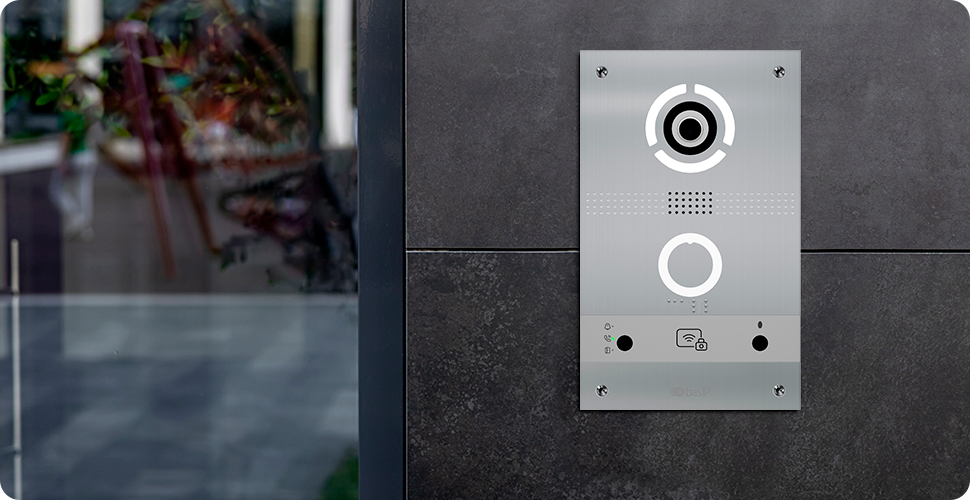
Induction Loop Output. The panel supports connection of an external induction loop interface. This means that the audio signal of the conversation is transmitted directly to hearing aids and cochlear implants equipped with T-coil mode, without the participation of the speaker and without background street noise. Imagine an elderly patient at the entrance to a clinic on a windy day: a standard loudspeaker is practically useless for him, but a signal received directly in the hearing aid gives clear, intelligible sound. This is exactly what makes induction loop output a critical function rather than a marketing addition.
Braille marking. The call button has Braille marking, allowing visually impaired users to navigate the panel independently without outside help. This meets the requirements of ISO 21542:2021 and is a standard norm for facilities with an accessible environment in Europe and the USA. A small detail, but for a person with a visual impairment it determines whether he can use the entrance independently.
Three-mode LED indication and voice prompts. Three LED indicators signal the statuses: call, conversation, and lock opening. For deaf users, for people in a noisy environment, and for those who simply found themselves at this entrance for the first time, visual feedback removes uncertainty. This is complemented by voice indication: the system voices statuses, creating a parallel audio channel for those who need it.
Together, these three layers form multichannel communication at the entrance: tactile, visual, and auditory. This approach corresponds to the principle of “universal design,” an environment that works for the widest possible range of users without special adaptation for each one.
Reliable housing
The procurement of equipment for public facilities is always a calculation of total cost of ownership. A panel that needs to be replaced or repaired before the contract ends is not savings; it is an administrative and financial risk.
AV-08FBIL is made of milled stainless steel. The IP65 protection rating means complete protection against dust and resistance to directed water jets; this is the norm for outdoor installation in any climatic conditions. IK07 defines resistance to an impact load of 2 joules, which corresponds to the impact of an object weighing 500 g falling from 400 mm. In practice, this is a panel that withstands daily intensive operation in residential and public buildings, including accidental and deliberate mechanical impacts.
The operating temperature range is from −40 to +65°C. This means a single specification for projects in Finland, where in winter it can be −30°C, and for facilities in southern Spain or in California, where equipment heats up under direct sunlight in summer. For large procurement programs with geographically distributed facilities, this simplifies standardization and logistics.
Convenient integration
Government customers and their integrators reasonably avoid equipment that works only inside the proprietary ecosystem of one vendor. Closed connection schemes limit competitiveness in repeat tenders and create dependence on a single service supplier.
AV-08FBIL is built on open protocols: Wiegand for compatibility with access control controllers of any manufacturer, ONVIF and RTSP for integration of the video stream into VMS systems, for example, Milestone, Genetec, Avigilon, and others, and Open API for connection to building management systems, HR platforms, visitor management systems, or custom municipal solutions. Power via PoE (802.3af/at) or 12 V DC provides flexibility during installation both in new and in existing buildings.
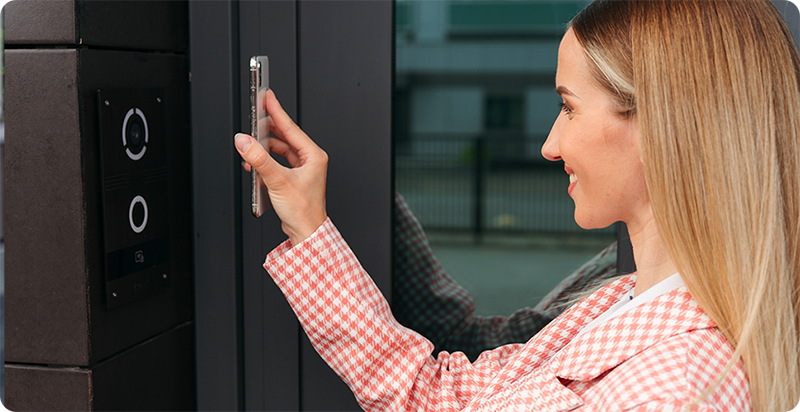
Additionally, the panel implements a built-in relay, inputs for door sensors, a tamper sensor, and support for several types of identifiers: mobile access, cards, key fobs, and QR codes. At facilities with different categories of users – permanent residents, employees, visitors, and contractors – this allows working with any access scenario without changing the equipment.
Where this is relevant
The combination of these characteristics makes AV-08FBIL especially appropriate at facilities where equipment is simultaneously subject to requirements of accessibility, durability, and integration compatibility. These are social and municipal housing, administrative buildings, medical institutions and clinics, educational institutions, service and staff entrances, parking, and technical areas.
In all these scenarios, the entry point serves not a homogeneous audience of regular users but a wide and unpredictable flow of people with different needs, habits, and levels of familiarity with the system. It was precisely for such an environment that AV-08FBIL was designed.
What this means for inclusion in the tender specification
The weakness of many entry panels in the tender context is that they do not give the customer specific, verifiable accessibility criteria. You can write “ensure accessibility for people with disabilities,” but it is difficult to justify exactly how this particular panel fulfills this requirement.
With AV-08FBIL, this is easier to justify: induction loop output is a verifiable function that complies with IEC 60268-16 and the requirements of EN 301 549; Braille marking is a tangible element recorded in the technical documentation; LED indication is documented functionality. All this can be directly transferred into the requirements of the tender technical specification and checked during acceptance.
This is exactly what distinguishes a product suitable for government projects from a product that simply “also works at the entrance.”
Considering AV-08FBIL for your project? Contact us.
How Can We Help?
- Get Inspired Discover what’s beneath our intercom
- Become a Partner Expand your business with BAS-IP intercom
- Check the Guides Download detailed manuals and schemes
Our contacts
- Sales: sales@bas-ip.com
- Technical support: support@bas-ip.com