
What PoE Is and Why It Is Useful for IP Intercoms
What PoE Means in Simple Terms
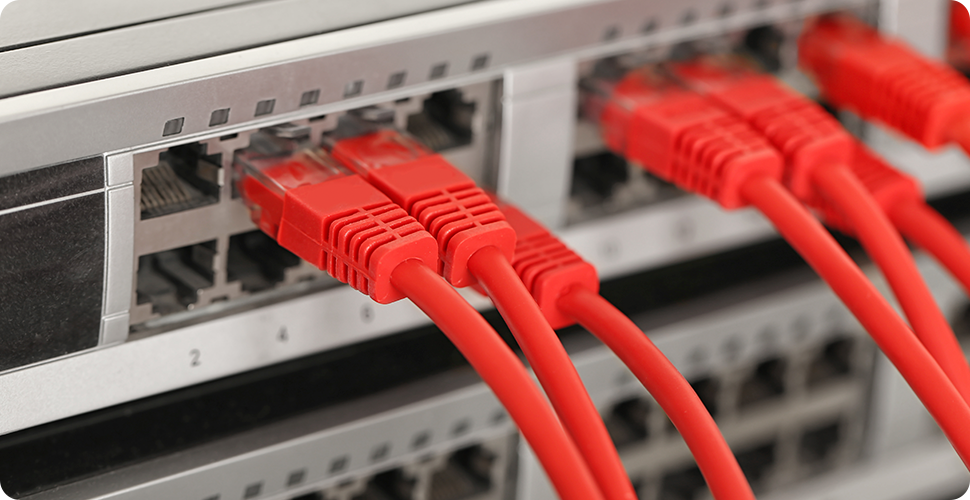
PoE stands for Power over Ethernet. Put simply, it means that the same Ethernet cable can carry both data and power.
That means that, for some devices, you do not need a separate network connection and a separate power feed. If the equipment supports PoE, one cable may be enough for both communication and power.
What This Looks Like in an IP Intercom System
In IP intercom systems, PoE is often used for entry panels, indoor monitors, and other network devices. A cable runs from a PoE switch or another suitable power source to the device, and that single line carries both data and power.
In practice, that makes the connection scheme simpler and cleaner. Instead of two separate lines, you have one.
Why It Is Useful
The main advantage of PoE is that it reduces the number of cables and makes the installation logic tidier. This becomes especially noticeable where the system includes several devices and there is no reason to multiply power supplies and additional cable runs.
PoE also makes life easier for installers: fewer power points, fewer separate adaptors, and fewer places where something can be wired incorrectly or untidily.
Another practical benefit is centralized power. If devices are powered through a PoE switch, they are easier to monitor, restart, and place within a backed-up power scheme.
What PoE Gives an IP Intercom System
For an IP intercom system, PoE is useful because the system is already built around the network. So it is logical when both data and power travel through the same infrastructure.
This is especially convenient on sites with several panels, indoor monitors, a concierge or security station, access controllers, and other network-based equipment. The cleaner the architecture, the easier it is to maintain and expand.
Even on smaller sites, there can still be value in it: installation may be simpler, and the system usually ends up neater and easier to service.
What You Need to Check in Advance
PoE is useful, but it does not mean that every IP device can simply be powered through the network cable without further thought.
First, the device itself has to support PoE. Second, you need to know which PoE standard and power level it requires. Third, the switch or injector must meet those requirements as well.
Even if you are already looking at a specific brand, such as BAS-IP, PoE support and power requirements still need to be checked model by model. You cannot assume that every IP panel or every indoor monitor within one brand is powered in exactly the same way.
It is also worth remembering that not every part of the system is necessarily powered in the same way. One device may work via PoE, while another may still require a separate power supply.
Are There Any Limitations?
Yes. Like any technical solution, PoE has limits.
PoE does not remove the need to think about network quality, cable length, power budget, and equipment compatibility. If the site is complex, the system still has to be properly designed rather than treated as though one cable will solve everything on its own.
In other words, PoE simplifies the system, but it does not replace sound engineering.
When PoE Makes Particular Sense
PoE is especially useful where the IP intercom system is being built as part of the wider network infrastructure of a site. That may be an office, a residential building, a commercial property, or a modern private house.
The more network devices there are in the system, the more obvious the value becomes: there is less need for separate power supplies and additional power lines.
If You Want the Short Version
PoE is the transmission of power and data over a single Ethernet cable.
For IP intercoms, it is useful because it simplifies installation, makes the system neater, helps centralize power, and fits naturally into a network-based architecture.