
Logo-Free Door Entry Panels: When and Why a Project May Need Them
Can a door entry panel be supplied without the manufacturer’s logo on the front?
For selected BAS-IP models and project configurations, yes. A logo-free front is one form of bespoke door entry panel customisation. BAS-IP can provide selected multi-occupancy panels for apartment buildings and individual panels for private homes or dedicated entrances without a visible BAS-IP logo on the front face.
This is not simply a theoretical option. We already receive requests for logo-free panels and have supplied them for projects where the entrance design, the identity of the building or local facade requirements make standard manufacturer branding unsuitable.
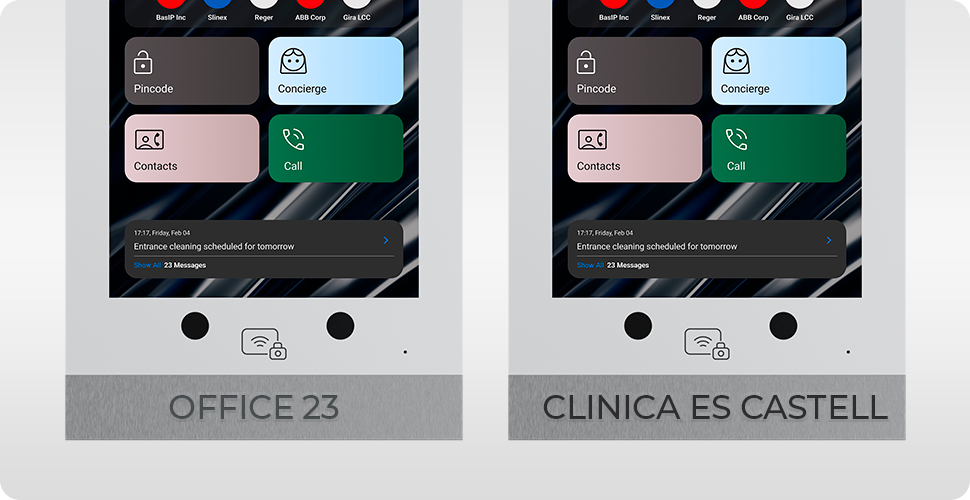
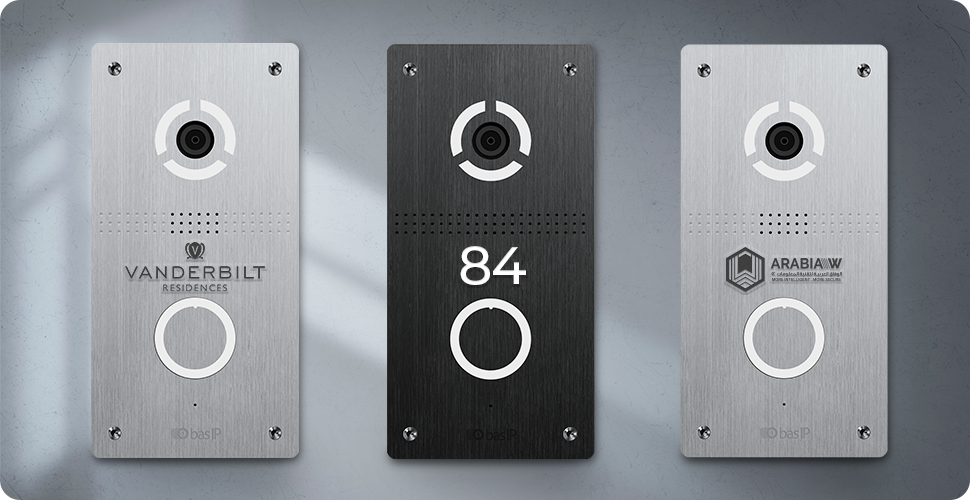
Some clients want a completely neutral front. Others replace the BAS-IP logo with the building name, house number, block designation or development identity. On more design-led projects, logo removal may be combined with a particular colour, finish, engraving or installation method.
The door entry panel should fit the building and the project brief, rather than requiring the architecture to accommodate a standard product appearance.
A door entry panel is part of the entrance architecture
In a catalogue, a logo helps identify the manufacturer and the product. Once the panel is installed, it becomes part of a much broader visual setting.
It sits alongside the entrance door, stone or metal finishes, lighting, building signage, access control readers, post boxes and wayfinding. In a carefully designed residential development or private home, all of these elements contribute to the first impression of the property.
On a standard project, a manufacturer’s logo may be entirely appropriate. It can also be useful where the equipment brand is specified or regarded by the client as an additional mark of quality.
On a carefully designed entrance, however, additional branding may feel unnecessary. Even a small inscription can become noticeable on a clean metal surface, particularly if it is engraved or applied in a contrasting finish. The panel may then look like a standard product added after the architectural concept had already been agreed.
In design-led projects, architects and developers may therefore treat the door entry panel not only as electronic equipment, but as part of the entrance architecture.
Why clients choose logo-free panels
There is no single reason behind every request. In practice, four scenarios appear most often.
The identity of the development or building
The client wants the entrance to communicate the identity of the property rather than the identity of the equipment supplier.
The panel may display the name of the residential development, building number, block designation, address or the developer’s branding. This is particularly relevant for new-build residential projects, where the scheme name, visual identity, materials and shared spaces have already been defined.
In this context, a panel without the manufacturer’s logo is not anonymous. It is more closely connected to the building itself.
Architectural restraint
Premium residential schemes, boutique apartment buildings and carefully designed communal spaces often use a limited palette of materials and visual details.
An additional inscription can interrupt that composition, especially where the panel is installed on natural stone, architectural metalwork, glass or another clean surface.
The architect may want the panel to remain visually quiet and avoid competing with the entrance door, building signage, lighting or other architectural elements.
Private homeowners’ preferences
Owners of private houses, villas and townhouses do not always want an equipment brand displayed on the facade of their home.
They may prefer a house number, family name, property name or a completely neutral front. This is particularly understandable where the panel is installed beside carefully selected stone, timber or metal finishes.
A consistent standard across a property portfolio
Managing agents and property owners responsible for several buildings may want a consistent approach to entrance equipment across their portfolio.
A neutral panel can work across buildings with different architectural styles without introducing additional manufacturer branding on every facade. Building identification, address information or operational markings can still be added where required.
Multi-occupancy and individual door entry panels
Logo-free execution can be relevant to both main categories of door entry equipment.
BAS-IP multi-occupancy door entry panels are used in apartment buildings, residential developments, aparthotels, mixed-use buildings and serviced residences. They are normally installed at the principal entrance, where they are seen every day by residents, visitors, delivery personnel, estate agents and building management teams.
In this setting, the development name, building number or block designation may be more useful than the manufacturer’s logo.
Individual door entry panels are used at private houses, villas, townhouses, offices, individual apartments and smaller commercial entrances. They are often installed next to natural stone, timber, architectural metalwork or rendered walls. A clean front face can help the panel sit more comfortably within that composition.
The choice is not limited to either a BAS-IP logo or a completely blank panel. Depending on the selected model and project requirements, the front may carry a property name, address, house number, development identity or functional engraving. Logo-free execution is therefore part of a wider bespoke door entry panel specification, rather than a single cosmetic change.
Available products can be explored in the BAS-IP door entry panel range.
What changes – and what remains BAS-IP
Removing the visible logo changes the appearance of the front face; it does not change the origin or identity of the equipment.
The panel remains a BAS-IP device supplied as a defined BAS-IP model. Its product documentation, software compatibility, warranty and technical support continue to follow the applicable BAS-IP supply terms.
Logo-free execution is project-specific customisation, not an OEM or white-label conversion into a third-party product. It should not be interpreted as anonymous hardware or equipment from an unknown manufacturer.
Any manufacturer identification required for compliance, service or traceability is handled in a form appropriate to the selected model and project configuration.
How BAS-IP handles logo-free and bespoke requests
Logo-free execution forms part of the wider BAS-IP project customisation programme.
Depending on the selected model and project brief, it may be possible to discuss:
- colour and finish;
- front plate material;
- dimensions and installation method;
- custom engraving;
- building name or house number;
- development, developer or managing agent branding;
- functional and accessibility markings;
- removal of the visible BAS-IP logo.
One project may require only a neutral front. Another may replace the standard logo with a building name or house number. A more detailed brief may combine logo-free execution with a specific colour, finish and marking system.
The final solution depends on the panel model, the architectural brief, the order configuration and the intended installation.
Heritage-sensitive and tightly managed properties
Some projects require closer review because the entrance forms part of a listed building, lies within a conservation area or is subject to additional controls imposed by a freeholder, estate owner, managing agent or another approval body.
For these properties, the issue is not the logo in isolation. The panel position, dimensions, finish, fixings, illumination, cable routes and visible markings may all affect the appearance of the entrance.
In England, alterations that affect the character or appearance of a listed building may require Listed Building Consent. Requirements vary by site and proposal, so the installation should be checked with the local planning authority or conservation officer before work begins. Historic England provides official guidance on Listed Building Consent.
Our separate guide, Door Entry Panels for Listed Buildings in London: What to Check Before Specification, explains the difference between listed buildings and conservation areas, who may need to approve the work, and why the panel, camera, reader, lighting and cable routes are best presented as one coordinated proposal.
Does a manufacturer’s logo require advertisement consent?
Not automatically, but the answer should not be assumed without considering the specific installation.
UK advertisement controls cover a wide range of signs and devices, and the need for consent can depend on their size, position, illumination and use. Signs attached to listed buildings may also require Listed Building Consent even where advertisement rules would otherwise permit them. The Planning Portal summarises the relevant advertisement consent rules.
For a small manufacturer mark integrated into a door entry panel, the practical approach is to consider it as part of the complete entrance proposal and confirm local requirements where the property is protected or tightly managed.
A logo-free panel does not have to look anonymous
Removing the manufacturer’s logo creates space for information that is directly relevant to the property:
- the name of the residential development;
- the building or block number;
- an entrance or core designation;
- the name of a private residence;
- the developer’s or managing agent’s logo;
- apartment or office information;
- functional and accessibility markings.
On other projects, the preferred solution is a completely neutral front containing only the controls and information needed by the user.
Logo removal should therefore be considered as part of the overall appearance of the panel. Colour, finish, material, engraving, mounting method and equipment configuration may be just as important.
When to discuss a logo-free or bespoke finish
The front-face appearance should ideally be agreed before the model is finally selected and the order is placed.
During design and specification, architects, developers, consultants and integrators should establish:
- whether the manufacturer’s logo is acceptable on the visible front face;
- whether the building name or project identity should be added;
- whether the building is listed or located in a heritage-sensitive setting;
- whether approval is required from a freeholder, estate manager or managing agent;
- whether a particular metal, colour or finish is needed;
- whether the panel will be flush-mounted or surface-mounted;
- which functional and accessibility markings must be included;
- whether drawings or visual mock-ups are required for approval.
Discussing these points early reduces the risk of selecting a standard panel and discovering later that its branding, finish or format does not suit the entrance.
A panel that belongs to the building
Logo-free execution is not the right choice for every project. In many installations, the standard BAS-IP front face is entirely appropriate. Manufacturer branding is not inherently undesirable.
The value lies in having a choice. Where the building has a strong visual identity, the architect wants a restrained entrance, a private client does not want third-party branding on the facade, or a historic setting requires a particularly careful approach, a logo-free panel may be the better solution.
BAS-IP can support this approach for selected multi-occupancy and individual door entry panels. The result is a complete IP door entry solution adapted to the architecture of the building, the needs of its users and the wider project concept.
Frequently asked questions
Can the BAS-IP logo be replaced with a building name or house number?
For selected models and project configurations, yes. The visible BAS-IP logo may be removed or replaced with a building name, house number, development identity or other project-specific markings, subject to production feasibility.
Is a logo-free BAS-IP panel an OEM or white-label product?
No. Removing the visible logo is a form of project customisation. The panel remains a defined BAS-IP product with BAS-IP documentation, software compatibility and product identification.
Does removing the visible logo affect the warranty or technical support?
Not by itself. The panel remains a BAS-IP device, and warranty and technical support continue to apply under the relevant BAS-IP supply terms.
Discuss your project requirements
| If your project requires a multi-occupancy or individual door entry panel without visible manufacturer branding, send us information about the building type, preferred panel, installation method and required markings. The BAS-IP team will review the available customisation options and help identify a suitable solution. Discuss panel customisation | Explore BAS-IP customisation options |