
Skip to Content
Go back
reading time: 3 mins

ButterflyMX Intercom System Comparison & Review

What is Butterfly MX

Butterfly MX is a very young IP intercom brand (founded in 2014), but it seems to be very motivated and ambitious to take a major share of the US intercom market.

Headquartered in New York, it covers one of most populous state in America. According to official figures, more than 6,500 people use the ButterflyMX intercom system every day.

How Does Butterflymx Work

One of the primary characteristics of Butterfly MX is the integration of smartphones in place of traditional indoor telephones or indoor video phones. All that’s required is a compatible iOS or Android device. Essentially, the Butterfly MX system is solely composed of the external intercom panel, offering a sleek and uncomplicated solution. However, this also presents a significant drawback. It necessitates the constant possession of your phone, ensuring it remains charged and that your data plan is up-to-date. Failing to do so may result in missed calls.

ButterflyMX Price & Monthly Cost

Price is another drawback of equipment from Butterfly mx intercom. You have to pay a considerable annually subscription fee of about 45 USD per each apartment. The average IP indoor monitor costs $200. That is, its payback would be a maximum of 5 years.

But back to the intercom panel. If the average market price of a multi-apartment intercom panel is 1500-2000 USD, the Butterfly security system costs 3 times more. To be honest, what caused this price is not very clear, because there is nothing outstanding in this panel. It does not even have a known protection rate, so it is very easy to break it, even with a blow. Who will pay for the replacement of an expensive panel?

See also  Videx Intercom System Review & Comparison

Recently, the Mxbutterfly company has been focusing not only on intercom systems in its purest form, but also on various solutions for home management companies. For example, special intercom solutions for the package rooms.

We have a lot of respect for ButterflyMX and what intercom software they are developing. While developing LINK property management software for the US market, we also discovered the Butterfly MX solution. We think we have already done a great job. Below you will find a comparison chart/review of BAS-IP and ButterflyMX intercom systems.

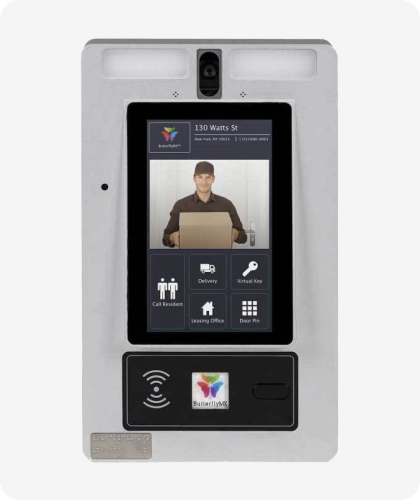
ButterflyMX Intercom

ButterflyMX vs BAS-IP Comparison

Feature BAS-IP Butterfly MX
Build-In Camera Yes, 2MP
Access Control EM-Marin/MIFARE*/NFC/ Bluetooth
Keyless Entry
Virtual keys (PIN codes) for visitors
QR codes for visitor access
Multifactor AUTHENTICATION
Property management software integrations
Measuring Temperature
Cloud-based access management
Indoor Phones
Indoor Monitors 7 models
Android Based Monitors
3rd Party APP Support
Mobile APP
Elevator control
Connected IP Cameras Integration
MIFARE Classic/NFC/Bluetooth
Looking for intercom system?
Disclaimer: The current comparison was made on December 7, 2021. The Comparison based on information we have available to us at the time of writing.

*BAS-IP supports Mifare Classic, Plus, Desfire EV1, Ultralight.

similar articles
Articles

The entry panel is the first point of contact between a building and a person. And if this building is municipal, social, medical, or educational, the panel at the entrance must be clear and convenient for everyone: the hard of hearing, the visually impaired, elderly people, visitors unfamiliar with the system. AV-08FBIL was designed precisely […]

Articles

A video intercom monitor is often treated as just a screen on the wall. In reality, it is one of the key parts of the system: it is the device through which the user receives the call, sees the visitor, speaks with them and manages access. What a Video Intercom Monitor Is A video intercom […]

Articles

When the word “SIP” appears in the specifications of an intercom or entry panel, it often sounds like something purely technical. In practice, the meaning is much more practical. SIP is a protocol used to establish communication between devices on a network. Put simply, it helps one system “call” another, establish a connection, and begin […]

Articles

When people first come across the term “IP video intercom,” it often sounds more technical than it really is. In practice, the basic idea is fairly simple. An IP video intercom is an intercom system that works over a network. In other words, communication between the entry panel, the indoor monitor, and other devices is […]

Articles

An entry panel is often treated as just “the button by the door.” In reality, it is one of the key elements of the intercom system. It is the device through which a call begins, audio and video are carried, and, in some cases, access, identification, and different entry scenarios are handled. So it is […]

Articles

Access control and a video intercom are often treated as though they were the same thing, because both are linked to entering a building. But they are not quite the same. A video intercom is primarily about communication with a visitor: the call, the conversation, the image, and the decision to release the door. Access […]

Articles

What PoE Means in Simple Terms PoE stands for Power over Ethernet. Put simply, it means that the same Ethernet cable can carry both data and power. That means that, for some devices, you do not need a separate network connection and a separate power feed. If the equipment supports PoE, one cable may be […]

Articles

Why This Comparison Is Often Presented Too Simplistically When people talk about the difference between an IP and an analog video intercom, the discussion is often reduced to a crude formula: analog is basic and outdated, while IP is automatically modern and better. That is a convenient story if someone only wants to sell IP […]

Articles

Start Not with the Design, but with the Use Scenario The most common mistake is choosing an entry panel without a clear task in mind. A panel for a private house, a block of flats, an office, or a commercial site is not the same thing. First, answer the basic questions: How many users will […]

Articles

What the Difference Actually Is A flush-mounted panel is recessed into the wall or into a prepared niche, so only the front face remains visible from the outside. That makes the installation look neater and more integrated. A surface-mounted panel is fixed on top of the wall. It protrudes further, but it is usually much […]