
Revolutionizing Android Based IP Video Intercoms
Secure and controlled access is vital for any building, be it an office complex, a private residence, an apartment, or a workspace. Video intercom systems facilitate seamless communication with visitors without direct contact, enabling occupants to see, talk, and remotely open the door if necessary. Such systems require an electromagnetic or electromechanical lock for operation and can be found in various forms, such as monitors, indoor stations, and intercoms.
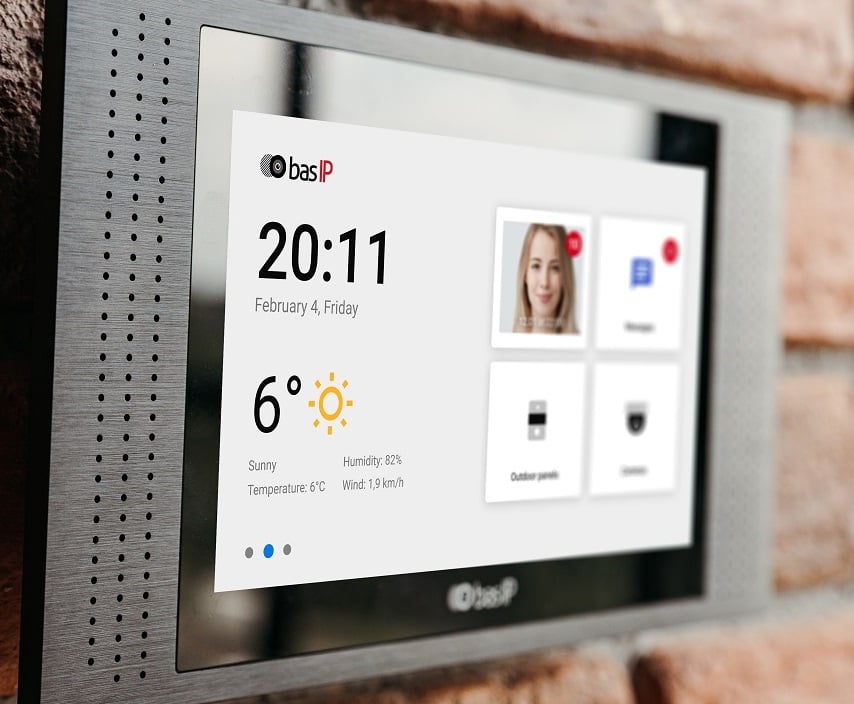
Intercom systems can be classified based on their features, functionalities, and other factors. One key distinction is between analog and IP devices. Hybrid devices, like analog intercoms with built-in Wi-Fi modules or wired Ethernet connections, also exist, which allow call forwarding from the panel to mobile devices for monitor and lock control. IP intercoms, while more expensive than analog versions, offer numerous advantages, including:
- Internal audio and video communication between users (intercom)
- Direct communication with concierge, house services, utilities, security, etc., from the intercom screen
- Integration with smart home automation systems and smartphone control
- Call receiving, conversation, and door lock control via mobile devices
- Informational notifications for residents from the administration or services
The Linux Connection
Currently, most IP intercom systems operate under the Linux Embedded operating system. As open-source software, Linux offers several advantages, such as low or zero acquisition cost, free acquisition costs, which in turn attracts corporate clients. Moreover, free public support enables companies to save significantly on software upgrades. Linux also provides numerous ready-made packages and libraries for free use.
However, Linux has its downsides. For instance, under the General Public License (GPL), companies using open-source software for their developments must disclose their source code. This requirement, although fair, is not always met, especially for highly commercial products. Another drawback is the mandatory use of the “console” add-on for actions related to launching, installing, or removing programs, as well as differentiating user rights.
Some manufacturers mention the Linux operating system in their devices’ specifications, while others claim to use their own OS. In most cases, Linux serves as the base, and the differentiation is a marketing tactic to stand out or justify higher prices. Overall, Linux has long been the most suitable, convenient, and commercially viable OS for intercom device software development.
The Android Era: Pros and Cons
But progress does not standstill. A few years ago, manufacturers thought about the fact that “you can not earn money with Linux alone.” And then many of them paid attention to the promising Android OS. For end-users, this operating system is associated with simplicity, convenience, and functionality. These qualities are the key to the success of devices built on the Android OS. Of course, not all companies quickly switch to the development of intercoms with the new OS, many conservative manufacturers will produce only Linux devices for at least a few more years. But more flexible and dynamic companies are already presenting their first Android models, which, despite some user fear of novelty, are a significant success.
The main advantage of intercoms that operate based on the Android OS is their significantly expanded ability to integrate with third-party services through the installation of additional applications. Moreover, these applications can be installed not only by developers but also by any end-user.
The only difficulty is that in most intercoms, the usual installation of applications by downloading them from the Android Play Market with your account data will not work. You will need to save applications in the device’s memory by writing, for example, to a microSD card, and then launch and install them.
Thanks to the innovation in terms of the new OS, devices have become faster, more reliable, and working with them is easier and more comfortable. The interface is familiar to everyone, ease of management and many settings are also on the side of new products.
Myths Related to Android Intercoms
Since Android is a relatively new solution and not many companies have already released their first samples that can be studied live, there are many rumors and myths about this innovation. Let’s deal with the most basic together.
- In a couple of years, the system will become closed
After studying many forums and talking to users live, we found out that their main fear and even some distrust of new products is caused by the story that in two or three years when Android intercoms become mainstream, manufacturers will close the possibility of self-installing any additional applications on their devices and make the system completely closed. But this opinion is fundamentally wrong since this solution is unprofitable even for the manufacturers themselves because easy integration with other services is a feature that distinguishes new intercoms from Linux versions. - Why should I buy an expensive intercom when I can buy a cheap Chinese tablet and connect it to the outdoor panel?
Yes, indeed, some outdoor panels support the function of call forwarding directly to the connected mobile device, without requiring the installation of an internal monitor. In this case, you can use the same tablet to see and hear your visitor, and then open the door for him. But still, the tablet will not be able to fully replace the video intercom without losing its functions. Firstly, the tablet device does not have the necessary connectors for connecting security sensors, alarms. Secondly, many intercoms have PoE power, which a tablet cannot boast of. The next difference is that without an intercom, you will never be able to remotely control smart home automation. The last one can be called the difference in the protocols of the connected interfaces, which is also reflected in the speed of the device. In addition, a pair of outdoor panels – a tablet is usually tightly tied to server architecture, while an Android intercom on a local network does not require any additional servers and will always work without failures.
That is, the tablet can be used as an addition to the intercom or as an extremely stripped-down version of it, but it cannot be called a full-fledged replacement for the video intercom.
Competitors or Not?
IP video intercoms occupy about 5% of the total number of devices on the intercom market. Intercoms based on the Android OS are another 5% of the previous five. This segment is now at the very beginning of development since the phase of the emergence of this trend was less than 5 years ago.
BAS-IP announced the release of two video intercoms AK-07 and AK-10 based on Android OS in early 2016. Both devices support the SIP protocol. The main difference between these monitors is the screen size, which is 7 and 10 inches respectively. The intercom has an internal memory, it also has a slot for an SD memory card up to 32 GB. This model allows you to control all connected home automation, including KNX devices. You can also connect up to 8 alarm loops to the intercom, which will work when danger occurs.
Prospects For Android In the Intercom Market
Despite the obvious advantages of the Android operating system, many companies will be producing Linux devices for a long time to come. As mentioned above, there is a certain share of the marketing component in this. By developing software on Linux, a company can eventually indicate the OS of its own development, thus showing its uniqueness, individuality, and even some kind of insubordination to general trends. A manufacturer can also make their OS private, and then its use will become very limited.
The strategy of using Android OS for video intercoms can be said to be aimed at the convenience of end-users, as they will be able to add all the missing applications themselves as they wish and integrate other systems, such as video surveillance or automation. And now is the best time to develop devices under the Android control system, since this segment on the market is still almost empty.
It is up to you to choose the manufacturer, intercom model, or operating system. The choice is between classics and new devices. But regardless of its OS, a high-quality video intercom is your indispensable assistant in ensuring security and peace of mind.